










How High Can A Drone Fly?
Once you take off and push your drone higher, you will eventually wonder where the actual ceiling is. The answer to how high you can fly depends on two very different factors. On the one hand, you have the legal boundaries set by aviation authorities to keep the skies safe. On the other hand, you have the physical and technical limits of the machine itself.
How Does Your Drone Measure Altitude?
Before determining your maximum flight height, you need to know how aviation measures distance. Drone pilots deal with two very different types of altitude.
AGL (Above Ground Level)
This measures the exact distance between your drone and the physical ground directly below it. If you hover 400 feet over a flat field, your AGL is 400 feet. If you fly over a 100-foot hill without changing your drone's actual elevation, your AGL instantly drops to 300 feet. Aviation laws rely on this measurement because it keeps your equipment from hitting trees, buildings, or low-flying aircraft.
MSL (Mean Sea Level)
This represents your true elevation based on the average ocean level, completely ignoring the terrain beneath you. You could launch from a mountain peak and be only 10 feet above the dirt (AGL), yet still be 10,000 feet above the sea (MSL). This metric dictates physical performance. As you climb higher above sea level, the air becomes thinner, which heavily impacts how well your drone's motors, batteries, and propellers function.

How High Can You Legally Fly Your Drone?
The legal maximum altitude for a consumer drone—from small hobbyist models to prosumer gear—in almost every country is exactly 400 feet (about 120 meters) AGL. Whether you are flying under the FAA in the United States, EASA in Europe, or the CAAC in China, you will face this universal limit.
A 100-Foot Gap Below Manned Aircraft
Manned aircraft, such as medical helicopters and small private planes, typically operate at 500 feet and above. By capping consumer drone flights at 400 feet, aviation authorities create a mandatory 100-foot safety buffer. This gap drastically reduces the risk of a mid-air collision. Simply put, the lower sky belongs to drones, while the upper sky is reserved for traditional aviation.
Lower Limits Near Airports
The 400-foot allowance only applies in uncontrolled airspace—areas far away from airports and military bases. Once you enter controlled airspace, your legal ceiling drops fast. Depending on how close you are to an active runway, your maximum permitted altitude might be restricted to just 100 feet, or you might be prohibited from taking off entirely.
Exceptions for Professionals
Commercial operations sometimes require going higher. Professional pilots who inspect massive structures, like suspension bridges or wind turbines, can obtain special airspace waivers. For instance, under the FAA's Part 107 rules, if a pilot needs to inspect a 600-foot radio tower, they are legally permitted to fly up to 400 feet above the very top of that specific structure, provided they stay within a tight radius around it.

Can Your Drone Stop You From Flying Too High?
Yes, beyond aviation laws, the drone itself will actively stop you from climbing higher. These built-in limits are programmed directly into the drone to keep you out of restricted airspace and prevent you from flying beyond what the machine was built to handle.
Different Drones, Different Software Locks
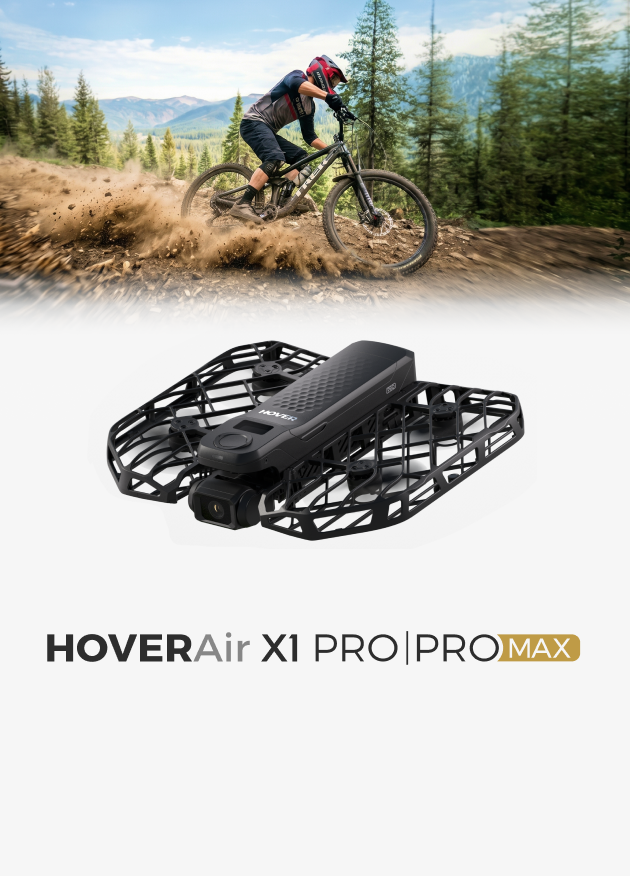
A drone's maximum height depends on what it is built to do. While traditional camera drones often stop at 500 meters (about 1,640 feet), dedicated action-tracking models like the HOVERAir X1 PROMAX cap out at 120 meters (about 400 feet). These limits can shrink depending on your flight mode—for example, restricting you to just 15 meters (about 50 feet) if the drone loses GPS and has to rely purely on visual sensors.
High-Altitude Takeoff Restrictions
Software limits also monitor your true elevation (MSL) because thin air makes it incredibly hard to fly safely. If you launch high up in the mountains, the system will step in to protect the motors. For instance, if you power on the HOVERAir X1 PROMAX above 2,500 meters, it triggers a "TAKEOFF ALTITUDE HIGH WARNING" to let you know flight performance might drop. Push that to 7,500 meters, and it will flash "TAKEOFF ALTITUDE TOO HIGH" and completely block the takeoff.
Permanent Limits and Professional Exceptions
For most consumer drones, these digital walls are permanently locked and cannot be turned off. Specialized enterprise drones built for heavy-duty commercial inspections or mountain rescues are the exception. With those specific professional models, certified pilots can submit their licenses and legal waivers to temporarily unlock the drone altitude ceiling for an approved mission.
Why Do Drones Struggle in Thin Air?
Software boundaries are only part of the equation. The moment you launch a drone in mountainous terrain, the physical environment becomes the primary challenge. As elevation increases, a severe drop in atmospheric pressure fundamentally changes how your hardware operates.
Thinner Air Reduces Lift
At sea level, higher air density provides enough resistance for propellers to generate lift easily. As elevation increases, the air becomes less dense. With fewer air molecules passing through the propellers, the drone generates less lift and loses flight efficiency.
Faster Battery Drain and Overheating
To compensate for the thinner air, the drone's motors must spin at higher speeds just to maintain a basic hover. This increased workload requires significantly more power, which drains the battery much faster than usual. Additionally, running at higher speeds causes the motors to generate more heat, increasing the risk of hardware overheating. A drone that flies for 20 minutes at sea level will have a much shorter flight time on a mountain peak.
Fly Smart, Not Just High!
Drone altitude limits come down to a strict balance: legal boundaries (AGL), the physical strain of thin air (MSL), and built-in software locks. Managing these variables can be exhausting when you simply want to film your adventures. Dedicated action-tracking drones like the HOVERAir X1 PROMAX remove this hassle entirely. By operating within a safe 120-meter bubble and automatically adapting to challenging environments, they manage the complex flight logic for you.
FAQs About Drone Altitude Limits
Q1: What happens if you fly a drone above 400 feet?
A: If you fly above 400 feet, you immediately enter the airspace used by manned aircraft, like medical helicopters and private planes, creating a severe risk of a mid-air collision. Legally, you face heavy fines from aviation authorities and could lose your pilot license. Technically, you also risk losing your radio signal, which often results in the drone flying away and crashing.
Q2: Why can't drones fly too high?
A: Drones are held back by three main factors. First, aviation laws cap consumer flights at 400 feet AGL to prevent crashes with airplanes. Second, manufacturers program built-in limits into the software to keep you out of restricted areas. Finally, physics plays a major role: thin air at high elevations (MSL) forces the motors to work too hard, draining the battery fast and causing the hardware to overheat.
Q3: How high can drones fly in the UK?
A: In the UK, the Civil Aviation Authority (CAA) sets the maximum legal drone altitude at 400 feet (120 meters) AGL. This rule applies to all consumer drones to ensure a safe distance from traditional aircraft. Flying higher than this limit requires you to hold a specific commercial authorization and apply for special permission directly from the CAA.
Q4: How high can drones fly in Australia?
A: In Australia, the Civil Aviation Safety Authority (CASA) enforces a strict maximum altitude of 120 meters (about 400 feet) AGL. Like in the US and the UK, this rule keeps your drone safely below the flight paths of manned aircraft. If you need to fly higher, you must have a Remote Pilot Licence (RePL) and secure explicit approval from CASA.


